
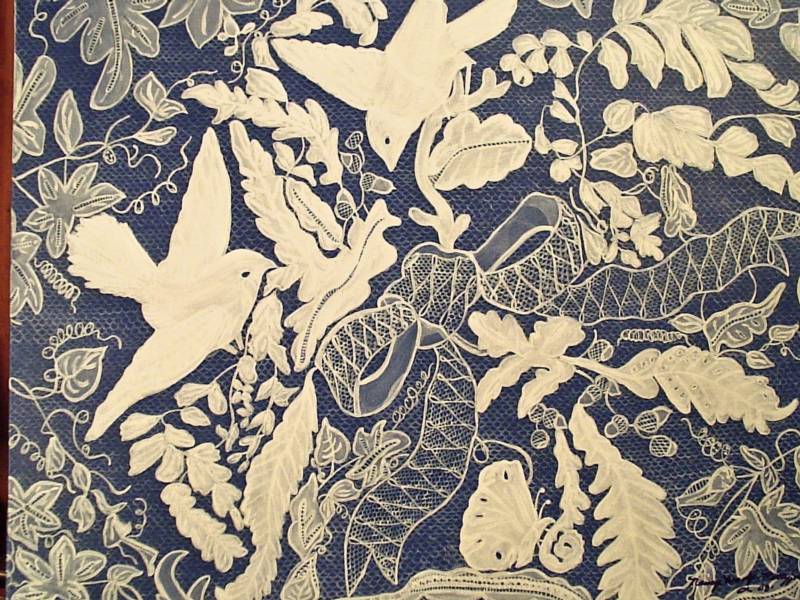
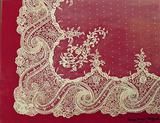
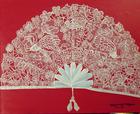
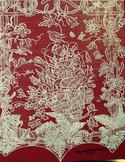
My name is Nancy Anne Woolf-Pettyjohn an artist of Historic Laces from around the world. From my extensive research as well as in talking to museum curators and directors the world over, publishers, and on the Internet I am told that I am the only artist in the world to paint authentic historic laces only.
Each lace is authentically painted by hand using acrylic paint and each stitch of the different netting painstakingly done given an attention to detail. All paintings come unframed and are painted on museum quality acid-free canvas.
All of my work has had prior copyright permission to use whether from museums from around the world, authors, photographers, publishers from around the world or private collectors.
All inquiries are most welcome as well as comments about my art work. Custom requests are also accepted. Custom prices will vary according to type of lace, how detailed, size and time involved. On custom requests three months will be needed to finish a painting unless otherwise written in response.
Museum and Gallery inquiries are also welcome.
For a little history lesson...
Lace making goes back to Biblical days when Jewish temple curtains were trimmed with embroidery.
Since 1100's-1200's men wore lace underneath their suits of armor.
In 1115 Royalty started wearing it such as Henry I wife Matilda. Henry II wore a lace ruff to cover his scarred neck.
In 1415 lace became the universal dress of Royalty.
Men, women and children became lace makers the world over for centuries.
The wealthy down through the ages have always commissioned lace makers from convents, and individuals from Chantilly, Venice, Genoa, and Brussels. Since lace making played a big part in a nation's economy rigid rules were set in place. Only the wealthy could afford it as the special talent, skill and love it took to make was often made using a single thread and needle. To make even the smallest piece of lace often took literally months.
During the revolution of the Edit of Nantes, they sent 4,000 lace makers away from Alencon. Many of these lace makers went into Amsterdam, Holland.
Then the Elector of Brandenburg edit had lace makers fleeing to Germany.
Soon France realized her mistake and her economy was suffering. France began importing lace.
Flemish lace has always been highly sought after to this day.
Under the reign of Napoleon I, France decided to start smuggling lace from other countries. He had tried to re-establish the lace industry but had miserably failed.
In a sixteen year period they starved to death 40,278 dogs! Skin was stretched over their emaciated bodies and stuffed with laces. They also rolled up laces and placed under the bodies of deceased people in their coffins.
Lace became so powerful that one country plotted against another. Many countries economy was suffering resorting nations to stoop to smuggling. Smuggling was done by any number of ways that included pirates, dogs, coffins, doll boxes, food and sheer greed.
Historically, men of good standing were known to mortgage their properties to buy it during the sixteenth and seventeenth centuries! At one stage things got so out of hand that France banned trade in lace to stop the country's entire output from being shipped out.
In a story by Thor Jensen that appeared on the Internet...WWW II Soldiers used lace curtains as snow camouflage on their helmets!
Lace is both historical as well as Fine Art.
Sources used in reference for this article:
Lace by Virginia Churchhill-Bath
History of Lace by Mrs. Bury Palliser
Powerhouse's Lace Study Centre
Rosemary Shepherd, Lace Maker and Lace Historian
Textile article: www.uts.edu.au/new/releases/2006/May/26.html
Written Acknowledgements:
Wm. H. Stouffer Missouri State Senator
Vicki Hartzler Missouri State Congresswoman
Note: Thank You to everyone who has been kind and supported my "efforts"!
_______________________________________________________________
Currently, known in 80 plus countries from around the world. _______________________________________________________________
Always nice to hear what others think about my artwork...
NOTE: No endorsements have been made in any way whether written, expressed or implied by these comments listed below or monies exchanged. It just goes to show that certainly art touches our very senses!
I think this is your gift of what you were meant to do in life!
Allhallows Museum Curator, Historiographer, Administrator Margaret Lewis: ...Some people have even thought it's real lace so that really is a compliment!
Intriguing!
Trustee Heather Toomer of The Costume Society in England,respected expert and museum advisor, authority of old lace and white embroidery, etc. : Impressive indeed! The results are absolutely splendid!
Holly Bedrosian Fine Art...Your lace art is incredible! I have never seen something like that. Great work!
Absolutely beautiful!
Cooper-Hewitt, National Design Museum Smithsonian:
"...very impressive indeed!"
Unbelievably beautiful!
...truly an art of rare quality and who would have known the part lace had in the past. The work look like it was done with a microscope.
Never seen anything like it! So beautiful!
This is really cool.
Wow! The ONLY person in the world doing this art.
Amazing talent...this is really something special.
This is the most beautiful thing I've ever seen !!!!!
Mauritshuis Museum's Mariette Halkema from the Hague in The Netherlands:
The lace pictures are beautiful.
Rosemary Cathcart, owner of The Sheelin Antique Irish Lace Museum and Shop:
I had a look at your site your work is amazing. When I looked at your pictures they remind me of the Hand drawn patterns which the Irish were worked on, which were usually drawn in White ink on a dark background and were as much a work of art as the actual lace - without the skill of the pattern designers there would be no lace !
It looks so real it gives me goosebumps! Literally! Look at my arms!
They are all so beautiful it makes me want to cry!
House of Elliot Collection: Clearly you are a talented lady!
Gulf Stream Media Group: unbelievably beautiful.
What a great gift God has given you.
Interweave Press: I don't know how you do it, but the more I learn the more intrigued I become!
Absolutely intricate an incredible amount of patience and talent.
St. Louis Art Museum: ...work is intriguing.
National Museum of American History: Impressive paintings of laces...interesting work.
You do beautiful work!
Allhallows Museum Curator Margaret Lewis: Not all the Trustees could get to the museum on Wed. because of the snow but when we opened the parcel there were lots of Ooohs and Wows!!
This is very intricate work. Amazing.
St. Louis Home Magazine: ...very intrigued by your work.
Your lace work is absolutely beautiful...you should be so proud.
Kemper Museum: ...most interesting.
museum: spectacular paintings!
Wow! Nancy, you do absolutely beautiful work!
Allhallows Museum Curator Margaret Lewis: The pictures are lovely!!!!! My husband recognised it and I did not even think he took notice of it!
I was amazed at the beauty of your work, such patience and detail!
The Trustees at Allhallows Museum according to the curator: they loved it 4 men 6 women.
The Jewish Museum Curatorial Program Coordinator - I'm delighted to have shared these materials with my colleagues.
Kathy Ireland model, actress, and CEO of her own brand name products:...read with much interest ...beautiful website!
Leigh Keno antique expert, author, tv host and owner of Keno Auction House-Your work is beautiful!!! I am amazed at the detail!!!
...looking through your website. I am astounded! It is really beautiful, and actually took my breath away.
I loved reading the history of lace. I had no idea of the importance of lace through the ages...
I'm telling you-it took my breath away. What a marvelous talent you have been given.
...you are very talented...keep up the wonderful work.
...looking at your art I am reaaly impressed. Amazed you could paint it so life like. Wonderful.
...also really enjoyed your portraits it takes a true talent to make a painting come to life as you have.
Ron Guthrie Artist Owner of Art by RC Guthrie
You do some great work with the lace paintings, that's pretty impressive, Nancy!
Her Majesty (Queen Elizabeth II) has written me via her Lady-in-Waiting three times as to her interest on my art as well as wishing me great success on my exhibit. "special artwork".
Thank You to everyone who has taken time from their own busy schedules to share with me your opinions of my Artwork.
Florals: Edmund's Roses ...Exquisite and unique!
from another...your work is even better than Georgia O'Keefe's!
MEA Nursery...website is extremely interesting
Heinz Playner Curator,Art Critic, Director of Paks Gallery of Austria...
Our curator team has seen your artwork and finds these very impressive.
"... Extraordinary Art..." by Artifactnyc
"...exceptional talent and the profound impact your work has had on the art community...", by Artour International Magazine.
"... beautiful video..." (Pheasants) LA Art Show by Salvatore Russo
"Artifact Puzzles - "Your artwork is lovely (I especially like your regal kudu!")
Peter Abello, Public Info. Specialist with Florida Dept. Of Atate/ Division of Arts and Culture-" Your work is awe-inspiring"
Artfinder ... These look great!

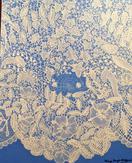
-Historic Lace Paintings- Historic Portraiture/Figurative-Natural Florals
Always Hand Painted & Painstakingly Accurate! My work is never done by painted photo enlargements or laser. Solely done with my own hand and eyes!
When you think of lace you always think of romance.........
so why not give the gift of lace
to that special person in your life
and start creating a little history of your own?
Contact : [email protected]
1 816 377 5533
KCMO Metro area
Welcome to my Art Gallery
Price Range- $100-$100,000 US Dollars PAYPAL
I have been blessed by God with a natural talent for art which enables me to be able to hand paint anything that i can see which makes my website very diverse. If you like my efforts thank God!
My artwork is for all to enjoy from budget friendly to high-end Residential to Commercial.
The paintings are available in Giclee Prints on museum quality acid-free canvas.
My Interior Decorating ideas in a 3 volume set containing 204
photos 5x5 inches using the Redecor App with prior copyright permission to do so.
Later to be available will be items for the home with my custom art on them..
World Master Artist and Illustrator
WHAT IS A GOOD INVESTMENT IN ART?
According to Michael Schwartz, CEO and Owner of Galerie Michael located in Beverly Hills,
Los Angles, Ca. http://galeriemichael.com
This is from his video on his website...Mr. Schwartz says in essence:
...that you want to invest in art that is relevant and that will be a continunum that even three, four or five centuries from now it will be deemed important because it was significant and groudbreaking and historic all part of the evolution of art of our age....
